
5 min read
What an ASME U-Stamp means for your pressure vessel
What the U-Stamp certifies, what the Authorized Inspector checks, how a Canadian CRN fits in, and what to ask a fabricator before you order.
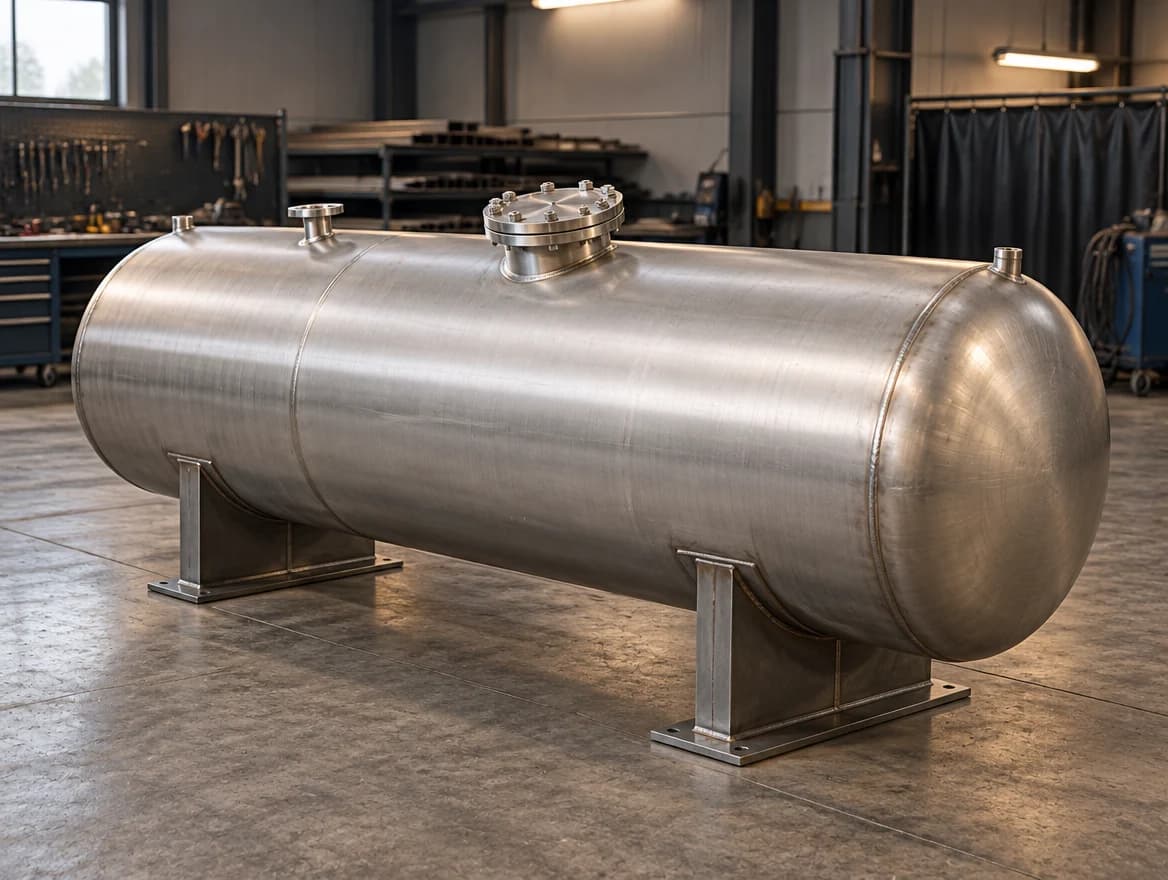
A nameplate with the ASME U mark tells you a lot about how a pressure vessel was built, and very little about whether it is the right vessel for your process. Knowing where that line falls makes it easier to write a purchase specification, and to review what comes back from the shop.
What the U-Stamp actually certifies
The ASME Boiler and Pressure Vessel Code, Section VIII, Division 1, sets rules for the design, materials, fabrication, inspection and testing of pressure vessels. A fabricator that holds the U-Stamp has been issued a Certificate of Authorization by ASME to build vessels to those rules and to mark the ones that comply. Formally, ASME now issues a single Certification Mark with a designator, such as U for Division 1 or U2 for Division 2; almost everyone still calls it the U-Stamp.
The certificate is not a product approval. ASME issues it after reviewing the shop's written quality control system and seeing that system demonstrated, and it has to be renewed every three years. In practice it means the shop has documented, audited controls for:
- Design calculations to the Code, including shell and head thickness, openings, reinforcement and flanges
- Material receiving, identification and traceability back to the mill certificate
- Welding with procedures and welders qualified under ASME Section IX
- Nondestructive examination (NDE) by qualified personnel, to the extent the design requires
- Pressure testing, final inspection and the Manufacturer's Data Report
- Control of drawings, nonconformances and calibrated measuring equipment
It does not tell you whether the materials suit your fluid, the corrosion allowance is realistic or your piping loads were considered. Those come from your specification and design review.
What the Authorized Inspector does
Every Code vessel is built under the oversight of an Authorized Inspector (AI): a third party employed by an Authorized Inspection Agency, typically holding a National Board commission. In some jurisdictions the regulator provides this service itself. The AI is independent of both the fabricator and the purchaser.
The AI verifies Code compliance; they do not design the vessel. Typical involvement includes:
- Confirming the design calculations and drawings are complete and available
- Checking that materials are permitted by the Code and match their certificates
- Confirming that welding procedures and welder qualifications are in place
- Reviewing NDE results and examining the vessel at agreed points during fabrication
- Witnessing the final pressure test
- Signing the Manufacturer's Data Report, usually Form U-1 or U-1A, before the vessel is stamped
If the AI is not satisfied, the vessel does not get stamped. That hold point is a large part of what the U-Stamp is worth.
Reading the nameplate
The Code requires specific markings, including the manufacturer's name, serial number and year built, the maximum allowable working pressure (MAWP) at a coincident temperature, and the minimum design metal temperature (MDMT). Further markings show the extent of radiography and whether the vessel was postweld heat treated.
Two of these deserve attention at the specification stage. The extent of radiography sets the weld joint efficiency used in the thickness calculation: for a double-welded butt joint, full radiography allows an efficiency of 1.0, spot radiography 0.85 and none 0.70. Less examination means a thicker, heavier shell for the same pressure. MDMT drives impact testing requirements, which matters for anything installed outdoors in a Canadian winter or cooled by its own process.
The final hydrostatic test is normally at least 1.3 times MAWP, adjusted by the ratio of the material's allowable stress at test temperature to that at design temperature.
Where the CRN comes in
In Canada, the U-Stamp is necessary but not sufficient. Under CSA B51, the design of a boiler, pressure vessel or fitting must be registered with the safety authority of each province or territory where it will be installed, and the registered design is assigned a Canadian Registration Number (CRN). In Ontario, that authority is the Technical Standards and Safety Authority (TSSA).
Registration means an engineer at the jurisdiction reviews the drawings and calculations before the vessel is built. The CRN is marked on the vessel, and the digits after the decimal point show which provinces and territories it is registered in. A vessel registered only in Ontario has to be registered again before it can be installed in Alberta or Quebec. Some small vessels are exempt, based on size and pressure limits that each jurisdiction sets.
Registration takes time, so it belongs at the start of the schedule, and a design change after registration may have to be resubmitted.
Questions to ask a fabricator
Before you place an order, it is fair to ask:
- Is your ASME Certificate of Authorization current, and does its scope cover this vessel?
- Who is your Authorized Inspection Agency, and at which points will the AI be involved?
- Who prepares the design calculations, and will the design be registered in every province where the vessel could be installed?
- Are your Section IX welding procedures qualified for these materials and thicknesses, and for impact testing if the design requires it?
- What radiography and other NDE are planned, and what joint efficiency does the design assume?
- What will the data package contain, and can we see a redacted example?
Clear answers to those six questions tell you more about a shop than any brochure.
- Pressure vessels & tanks
- Quality documentation